A portrait of the artist as a con man.

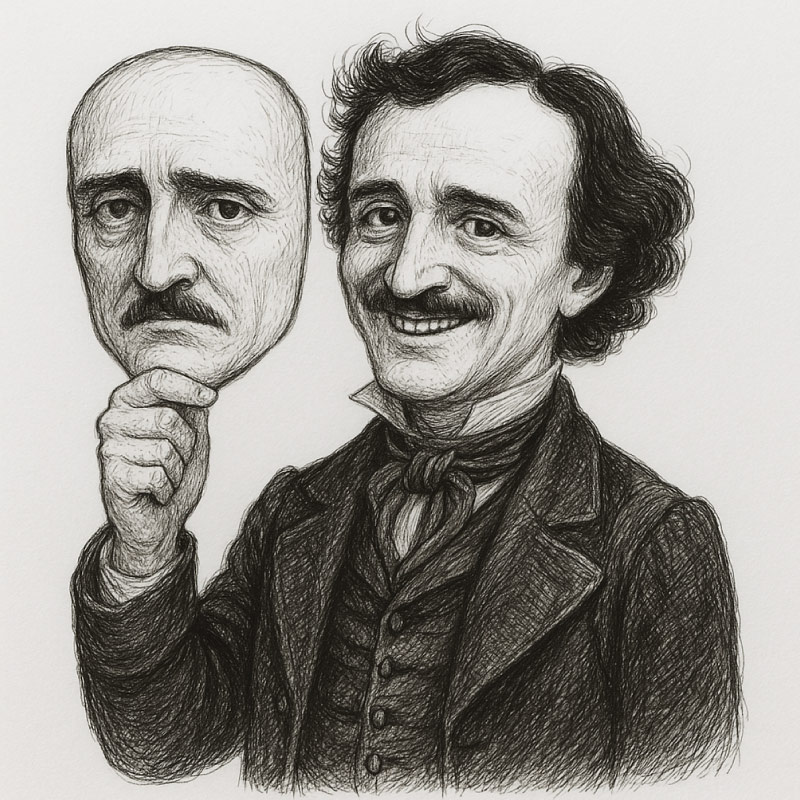
In 1837 Poe published a story about a man who fooled everyone.
The story, “Mystification,” appeared after Poe’s earliest tales were published: a clutch of travesties and subtle satires that many readers took seriously.
The protagonist is Baron Ritzner Von Jung, a student at Göttingen University, possessed of such extraordinary talents that he dominated all those around him. The tale describes him thus:
- He was recognized by one and all as “the most remarkable man in the world.”
- No one ever considered him capable of a joke, although in fact he was the secret author of “the most egregious and unpardonable of all conceivable tricks, whimsicalities, and buffooneries.”
- He was “one of those human anomalies now and then to be found, who make the science of mystification the study and the business of their lives.”
- In stature, the narrator says, he was “about my own height, say five feet eight inches.” (Poe was five-eight.)
- “His face was somewhat angular and harsh; his forehead was lofty and very fair.”
- He played a trick on a schoolmate involving a book, which appears erudite, but is actually double-talk. Although: if one has the key to deciphering it, it presents a perfectly sensible, comical story.
“Mystification” is undoubtedly a self-portrait of Poe. The timing of its appearance suggests that he meant to give a hint about those tales that readers had taken seriously, and also about works that shortly followed: the scary-seeming stealth mysteries “Ligeia,” “The Fall of the House of Usher,” and “William Wilson.”
But “Mystification” captures more than what Poe’s writing was about. It captures who he was: a born trickster, devoted to practical jokes, masquerade, buffoonery.

Such is not people’s idea of Poe.
But people’s idea—that of a man tormented to the point of madness by his dark vision—is a myth. A mass of evidence controverts it, yet it persists.
This image was foisted on the world by one Rufus Griswold, a prominent literatus and bitter rival of Poe’s. Upon Poe’s death, Griswold published in the New York Tribune an obituary that depicted Poe as beset by demons, roaming all night through wild storms, his “heart gnawed with anguish, [his] face shrouded in spirits.” Griswold twisted some events from Poe’s life, fabricated others, and even doctored Poe’s letters to discredit his character and in some cases to burnish Griswold’s own.
The electrifying profile naturally went viral, republished in newspapers and magazines across the country. Subsequently Griswold managed to become Poe’s literary executor, and in publishing Poe’s work he included an expanded version of the libelous obituary. Thus did Griswold’s fantasy become accepted fact.
Poe’s contemporaries pushed back at Griswold’s profile, but instead of presenting portraits of the real Poe, most of them offered alternative myths. Sarah Helen Whitman, poet, spiritualist to the literati, and Poe’s onetime fiancée, described him as a “prophetic genius,” possessing “peculiarities of psychical and physical organization” that enabled him to tune into “subtle variations of an ethereal medium” beyond the senses of ordinary people.
James Wood Davidson, literary editor of the New York Evening Post, declared Poe a “soul not understood,” dwelling in “imperial isolation,” whose characters were monstrous reflections of his own heart.” This, essentially, is the popular image of Poe as the tortured artist, the tragic soul whose vision and sensitivity doom him to suffering. It’s a timeless myth, handed down from Goethe, Byron, etc., etc., and applied freely to artists with tragic lives.
Davidson followed Griswold in conjoining Poe’s psyche with the characters in his fiction. In the twentieth century that connection was cemented by Freudians—generations of them—who analyzed Poe’s tales as they would a person’s dreams, using their images to explain Poe’s own supposed psychopathology.

Reality intrudes. A little.
Research over the past hundred years has brought forth a mountain of facts about Poe, which ought to have demolished the myths.
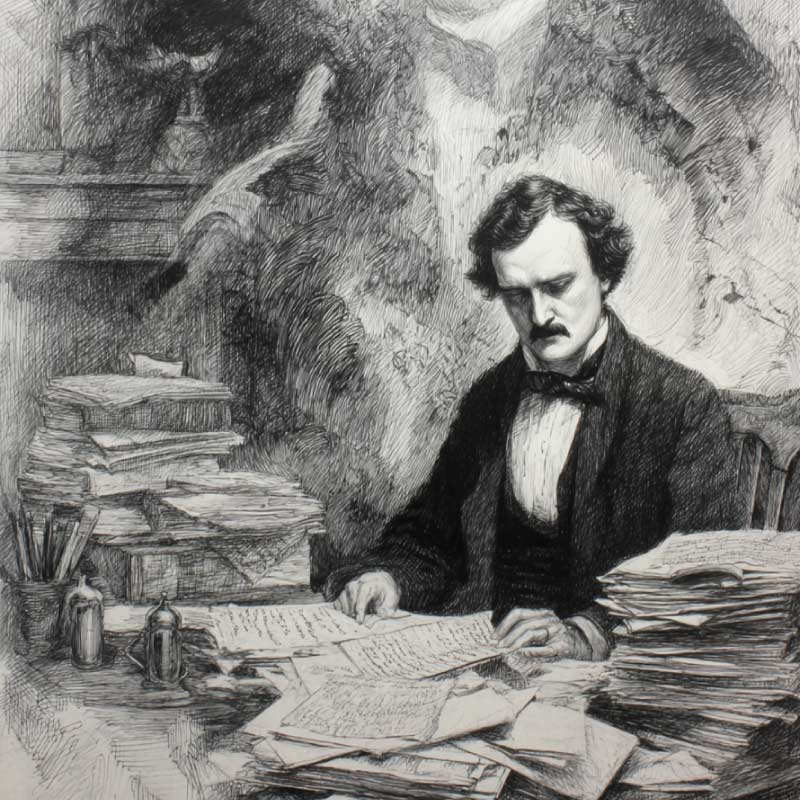
This research centered Poe where he lived and worked: not in an imagined garret, immersed in solitary dreams, but in a succession of magazine offices, scrambling to get ahead in a bare-knuckles, low-margin business.
Here we see a savvy go-getter, tirelessly networking and ceaselessly promoting himself and his magazines.
A prolific literary critic, whose keen-edged commentary is considered to this day among the most incisive of all time.
A journeyman writer, very much focused on what would sell. Pumping out features such as a series on cryptography and one that amusingly matched profiles of prominent authors to the characteristics of their handwriting.
Despite this body of research, the myth of tormented, solitary Poe has not been dispelled; again and again it has been woven back into the factual record.
Thus, for example, it became recognized that Poe’s practice of slashing criticism and personal attack was not peculiar to him, but commonplace in his time (indeed he deliberately adopted it from Britain’s leading critics). Even so, scholars declared that the vituperation in Poe’s case stemmed from bitter resentments deep in his psyche.
Or take his alcohol abuse. In depressing fact it looks just like most people’s. He drank heavily and behaved badly when he did; succeeded in quitting for long stretches, but often relapsed; sometimes acknowledged his abuse, sometimes denied it, and sometimes engaged in self-pity; and never overcame his dependency. It had disastrous consequences throughout his life, just as it does for others caught in its grip. Yet when Poe’s story is told, the drink is not taken as the problem, only a manifestation of some deeper problem, which his chronicler is ready to supply.
The result is a literature on Poe that, while adding much context, has not supplanted the traditional image.
Yes, Poe had problems in his life—serious ones. The greatest of these came not from psychic demons, but demon drink, which lost him friends and also jobs, reducing him at times to crushing financial distress. He also suffered from depression (not insanity), another common condition (which is recognized as related to alcohol dependency). Think Robin Williams, Richard Pryor, Jonathan Winters.
People with such serious problems can be comical. But with Poe we haven’t separated his problems from his personality from his work, and this continues to blind us to his humor.
By nature Poe was a trickster.
Like the Baron Von Jung, devoted to masquerade, dissimulation, malarkey.
This is a man who:
- Hoaxed New York with a fake story, featured on the front page of New York’s leading newspaper, reporting a flight across the Atlantic via hot-air balloon.
- Faked out the U.S. Senate with the purported memoir of the first white man to cross the Rockies.
- Kicked up a rumpus by accusing the revered Henry Wadsworth Longfellow of plagiarism. When the controversy died down, he reignited it by posing as an acquaintance of Longfellow, attacking Poe’s claims, and suggesting that Poe himself was guilty of plagiarism.
- Created a sensation with a tale about a man who dies while under hypnosis, and then goes on to explain the nature of life after death. Some people believed the tale was factual. A year later, Poe wrote another version of the story, this one even more outrageous.
In his time, Poe’s love of hoaxing was widely known, as you can tell from a comment made by a prominent New York editor, Mordecai Noah, when the balloon article appeared. The editor reprinted the article, adding a note. If the story is true, he wrote, “there will probably be a demand for the material whereof gas is formed. We would recommend any company to engage Mr. —–, he being the greatest condensation of gas that we know of.”
Noah’s comment was all in fun (he was a friend of Poe’s). My point is that the joke could only hit home if it was referencing a quality that people recognized in Poe.
A similar point may be made in relation to James Russell Lowell’s famous description of Poe as three-fifths genius and two-fifths sheer fudge.

Fudge, gas, or mystification, it was the center of Poe’s life.
He peopled his fictional world with purveyors of imposture.
- The aptly named Dupin, garrulous spewer of spurious profundity.
- Hans Pfaall, “proving” how, contrary to what scientists think they know, a balloon can certainly travel through space.
- The narrators of “The Premature Burial,” “Morning on the Wissahiccon,” “Von Kempelen and His Discovery,” “Mesmeric Revelation,” and “The Facts in the Case of M. Valdemar,” all of whom pretend to tell factual stories, before revealing their jokes at the end.
- The narrators of the stealth mysteries, whose horror, bewilderment, and self-pity all are feigned.
- The narrator of “The Imp of the Perverse” and countless others, who preface their varied stories with faux-erudite observations on some phenomenon not sufficiently appreciated.
In his non-fiction, writing in his own name, he serves up the same sort of malarkey.
You find it in:
- His literary reviews: now slashing, now pedantic, now aggrieved, but always striking a pose.
- “The Philosophy of Composition,” in which he elaborates his fatuous declaration that “the death . . . of a beautiful woman is, unquestionably, the most poetical topic in the world.”
- “Eureka!”—the explanation of the universe that was going to make Isaac Newton look like a schoolboy.
- His critical review of himself, in which he praises his “earnest” style—before adding that, “A writer must have the fullest belief in his statements, or must simulate that belief perfectly.”
In real life the practical joker, while perhaps not common, is someone we have all encountered. This is the person (more often a man than a woman, I believe), who comes into the office and announces, “They are towing away all the cars on the south side of the building.” The one who every day surreptitiously moves an object on your desk. Poe called it “mystification”; today it is more often termed “messing with” someone.
Many people find little humor in such behavior, and perhaps this helps explain why people don’t consider Poe funny. Those who engage in practical joking do think it funny. Poe delighted in it, and captured that delight again and again:
- The sly delight of the narrators of the stealth mysteries, planting their devious, taunting clues.
- The secret delight of the diddler, who after a long day of scamming people, goes home, gets into bed—and grins.
- The chortling delight of the editor William Blackwood, as he demonstrates how tales “full of taste, terror, sentiment, metaphysics, and erudition” can be ginned up from cheesy gimmicks.
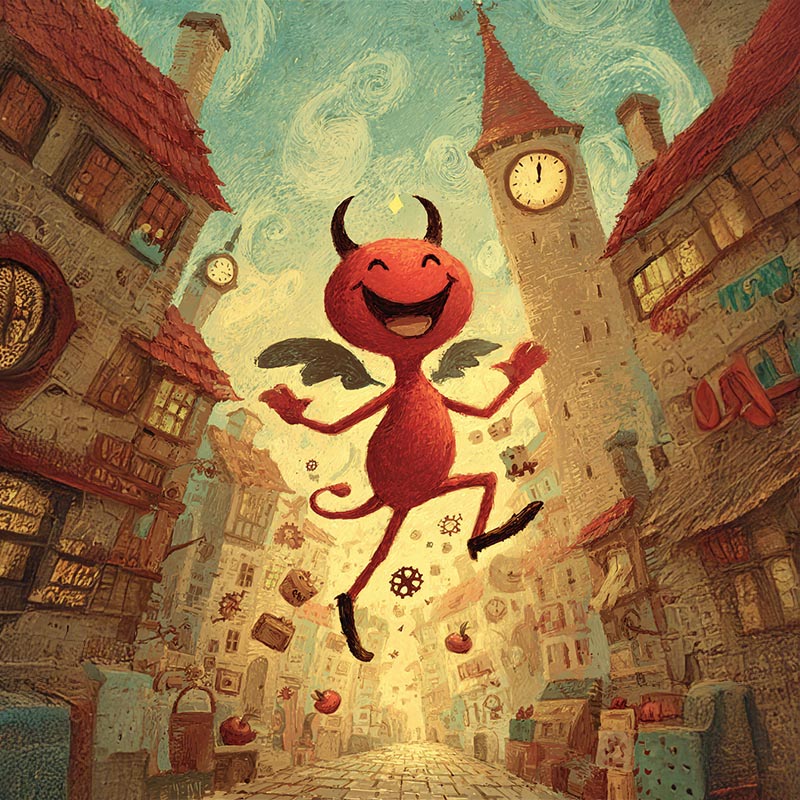
- The irrepressible delight of the grinning devil who, coming to mess with the town clock in the uptight village of Vondervotteimittiss, chassés and pirouettes through town and pigeonwings himself into the belfry.
This is not the Poe most people know, and may not be the one we want. But it’s who he was and what he was about.
Poe Unmasqued
Two books reveal his long-hidden secrets.