In Poe’s tales, one theme dominates,
and it’s not terror.

Most people would be astonished to hear
that Edgar Allan Poe was a humorist.
But it is plainly to be seen, if you simply look at the body of his fiction. The majority of his sixty-six tales are openly comical. Others are subtly so. Their humor ranges, from the wacky to the whimsical, from the urbane to the distinctly crude.
You can get a more accurate sense of Poe’s work just by reading some of the titles:
The Duc De L’Omelette
Why the Little Frenchman Wears His Hand in a Sling
Never Bet the Devil Your Head
Three Sundays in a Week
The Literary Life of Thingum Bob, Esq.
Some Words with a Mummy
X-ing a Paragrab
An overlapping group of tales, about two-thirds of Poe’s output, involve tricks. Some of these are openly comical, but a good many are not. Some tell stories about tricks; others play tricks on the reader.
But our idea of Poe’s fiction, his interests as a writer, is not based on this body of work. It’s based on a select group of tales, about a dozen. These are the stories people know, the ones that are printed and reprinted in volume after volume, decade after decade.
The list is not set in stone, but looks something like this:
Ligeia
The Fall of the House of Usher
William Wilson
The Pit and the Pendulum
The Tell-Tale Heart
The Black Cat
MS. Found in a Bottle
Metzengerstein
The Purloined Letter
The Cask of Amontillado
The Masque of the Red Death
The Murders in the Rue Morgue
These works have a key feature in common: they look dark. They draw us into a world of things unknown and terrifying, delivering us thrills and chills. (They also invite speculative and allegorical readings, the holy grail of literary critics.)

In fact, these tales are tricks—which makes them quite like Poe’s other tales. The first six are stealth mysteries: works that pose as tales of terror but hide logically solvable mysteries. “Metzengerstein” and “Ms. Found in a Bottle” are spoofs (as are “Ligeia,” “The Fall of the House of Usher,” “William Wilson,” “The Assignation,” and “The Man of the Crowd”). “The Purloined Letter” and “The Cask of Amontillado” contain stunning secrets that have only recently been uncovered. I will be posting on these tales in the months to come.
That these tricks fooled us—all of us—for so long is mind-boggling, and at the same time understandable. The dark terror swept us away—as scary stories do. The hints of something different never stood a chance.
The way these works—as opposed to the plainly comic bulk of Poe’s fiction—came to be seen as representing his true interest is also easy to see. These are the tales readers preferred; these are the ones that got published and republished. Moreover, these works meshed with our image of Poe himself. We thought he was dark and tormented . . . the men in his tales appeared dark and tormented . . . everything fit. (Well, except for all those comical tales, but what are four dozen stories among friends?)
So, it was nobody’s fault that our perception of Poe’s work bears no resemblance to reality.

But then the simple story becomes peculiar.
Not everyone was taken in by the terror. Just as scholars began challenging the myth of Poe, so many of them began re-examining his works. To begin with, they separated him from his first-person narrators. The things these characters say and how they speak, it was argued, tell us about them, not Poe.
This was the time of New Criticism, a movement which abjured consideration of an author’s personal life, and focused on the text itself. Literary works, New Critics insisted, are consciously designed, their elements—imagery, diction, etc.—carefully created and deployed. To come to terms with a work means analyzing these elements and the ways they interrelate.
Applying this perspective to Poe’s best-known tales, critics unearthed wonders. Some, noting the narrators’ unreliability, traced out new stories lying beneath the men’s versions. The tales were not really about those wild events they depicted, but rather the inability of the narrators to apprehend their true circumstances. (The possibility that the narrators were not merely confused, but deliberately hiding what they knew was not considered.)
Others focused on discordant elements in the tales. The wild diction, for example, which ranges from over-the-top to tone-deaf to positively hokey. And the comical bits of business, like the “Mad Trist” episode in “The Fall or the House of Usher.” What we have here are surreptitious works of satire, burlesque, and camp.
One by one, works that had been taken seriously were identified as spoofs or jests: “Ligeia,” “The Fall of the House of Usher,” “William Wilson,” “The Assignation,” “Metzengerstein,” “The Man of the Crowd.”i
Poe’s secret was out. “Prefer as we may to concentrate our attention upon the aesthetic, the cosmological, the metaphysical, or the moral strata of [Poe’s] work,” wrote the critic Robert Regan, “we have no choice but to acknowledge that beneath all these lies a bedrock which is a conglomerate of hoax and banter and satire.”ii
But, he continued, the critical work was just beginning. A thorough examination was needed to understand what Poe’s kidding was all about. Poet and critic Richard Wilbur agreed: solving this “mystery” should be Poe scholars’ primary object of study.iii
This was half a century ago. What happened?
The work of these critics has never been discredited, yet their discoveries about Poe’s work are practically unknown. Some scholars have indeed pursued the subject of Poe’s hoaxing, but mainly along the lines of abstruse literary theory. Others, including prominent Poe scholars, have chosen to disregard the jesting, or pay mere lip service to it, while pumping out tome after tome serving up the same old take on tormented Poe and his tales of darkness, decay and terror.
I will have plenty to say on this subject in my blog. What I offer at this point is the following very brief guide to Poe’s fiction—a mere list—which is designed to do nothing more than make one simple fact clear. That Poe was about trickery.
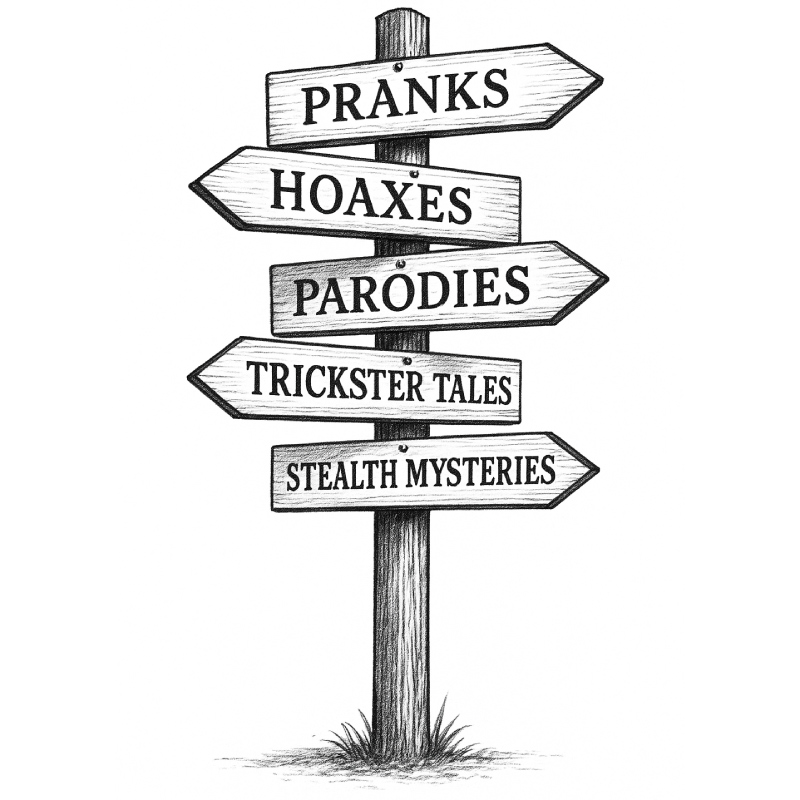
A Brief Guide to Poe’s Jests
Below I list forty-one of Poe’s sixty-six tales. The other one-third are a motley bunch, most of them peculiar and of doubtful earnestness. I have omitted them because, frankly, I don’t get them. I believe that most or all of them involve trickery, but I don’t want to identify them as such when I am unable to state the nature of the trick.
I have arranged the works according to the kind of trickery they employ (whether a hoax, a puzzle, a parody, etc.) and the manner in which it is employed (obvious or veiled, comical or serious). My point is that behind the remarkable variety we find in Poe’s fiction, the constant is trickery.
NOTE: This list is neither complete nor definitive. Other tales are certain to join the list. Also some works could be placed in more than one group.
I. Trickster stories—in which one character tricks another.
A Tale of Jerusalem. Roman soldiers pull a prank on observant Jews.
Mystification. A student befuddles a rival with a wacky book.
The Devil in the Belfry. The devil visits the uptight village of Vondervotteimittiss to mess with the town clock.
Never Bet the Devil Your Head. A man fond of the expression “I’ll bet the devil my head” gets a visit from Old Nick.
The Angel of the Odd. The angel of mischance wreaks havoc on a skeptic. (The story fakes out the reader, too.)
The Duc de L’Omelette. Snobby aristocrat, finding hell’s furnishings not to his standards, finagles his way out.
Three Sundays in a Week. Clever fiancée outfoxes her intended’s crusty, musty, fusty great-uncle.
Diddling. A disquisition on scams, with multiple examples.
The Business Man. A schlemiel’s version of “Diddling.” Loser boasts of penny-ante swindles.
*The Purloined Letter. Detective takes prefect of police for 50,000 francs, and exacts revenge on rival.
*The Cask of Amontillado. Narrator exacts mortal revenge for unspecified insult.
Hop-Frog. Jester takes horrific revenge on cruel king and his courtiers.
X-ing a Paragrab. Newspaper editor messes with rival’s type.
*Includes an important secret only recently discovered.
II. Tales that play tricks on the reader.
A. Hoaxes. Works that pose as factual.
The Balloon Hoax. Fake news story about a trans-Atlantic balloon flight, published in the New York Sun.
Journal of Julius Rodman. Bogus “discovered” journal supposedly kept by the first “civilized man” to cross the Rocky Mountains.
B. Pranks. Works that at first appear factual, but end in obvious gags.
Morning on the Wissahiccon. Apparent nature piece undercut by comic twist.
The Premature Burial. True accounts of people buried alive give way to a self-admitted “bugaboo tale.”
The Facts in the Case of M. Valdemar. Clinician’s precise notes on the hypnosis of a dying patient end in gross-out denouement.
Mesmeric Revelation. Prototype of “Valdemar” with restrained-by-comparison ending.
The Imp of the Perverse. Apparent reflections on a quirk of human nature swerve into an account of a murder and its aftermath.
C. Guessable Mysteries. Tales about elaborate tricks,with clues that allow readers to suss out what’s really going on.
(1.) The solutions are explained at the end; tales usually comical.
The Spectacles. Man too vain to wear glasses is tricked into marrying his great, great grandmother.
The System of Doctor Tarr and Professor Fether. Man visits insane asylum noted for its progressive methods.
Thou Art the Man. Wry account of a local murder case.
The Unparalleled Adventure of One Hans Pfaall. The title character claims to have traveled to the moon. The story is often called a hoax, but is actually a story about a hoax—the object of which is a puzzle for readers to solve.
The Gold-Bug. Most modern readers pick up this tale knowing what it is about, but for a naïve reader there is a mystery to be solved. (Not comical.)
The Sphinx. Unlike others in this group, this tale is a slight jest of Poe’s, involving a man sighting a huge, horrible creature. (Comical only at the end.)
(2) The solutions are not explained; the tales appear serious.
Ligeia. A man’s first and second wives both die. He says the second one was killed by the ghost of the first.
The Fall of the House of Usher. The narrator says that his friend’s sister came back from the dead and scared him to death. But the evidence is buried beneath a collapsed mansion.
The Tell-Tale Heart. The narrator, an admitted murderer, swears he is not mad, but convinces every reader that he is.
The Black Cat. The narrator kills his wife with an ax. He says his dead cat’s ghost made him do it.
The Assignation. An inexplicable sequence of events one night, and two people poisoned the next morning. The narrator says he knows what happened, but he doesn’t say what.
The Man of the Crowd. The narrator follows a man around London for twenty-four hours. He says the man’s movements were aimless; readers may beg to differ.
The Oblong Box. The narrator observes a pine box six feet long and two and one half feet wide and of a “peculiar” shape. He says it must contain a painting.
A Tale of the Ragged Mountains. A man dies from the application of a poisonous leech. Was it an accident, or metempsychosis? Or something most foul?
William Wilson. The narrator says there were two William Wilsons, one real, one fake. He says that he is the real one: the other one, unfortunately, is dead.
A Descent into the Maelström. A man recounts a frightening shipwreck, in which both his brothers perished and he miraculously survived. When he tells his friends what happened, they don’t believe him.
The Pit and the Pendulum. The narrator minutely describes the places in which he was held captive, but the details don’t add up.
D. Tongue-in-Cheek Parodies. Parodies that are so subtle that many readers take them seriously.
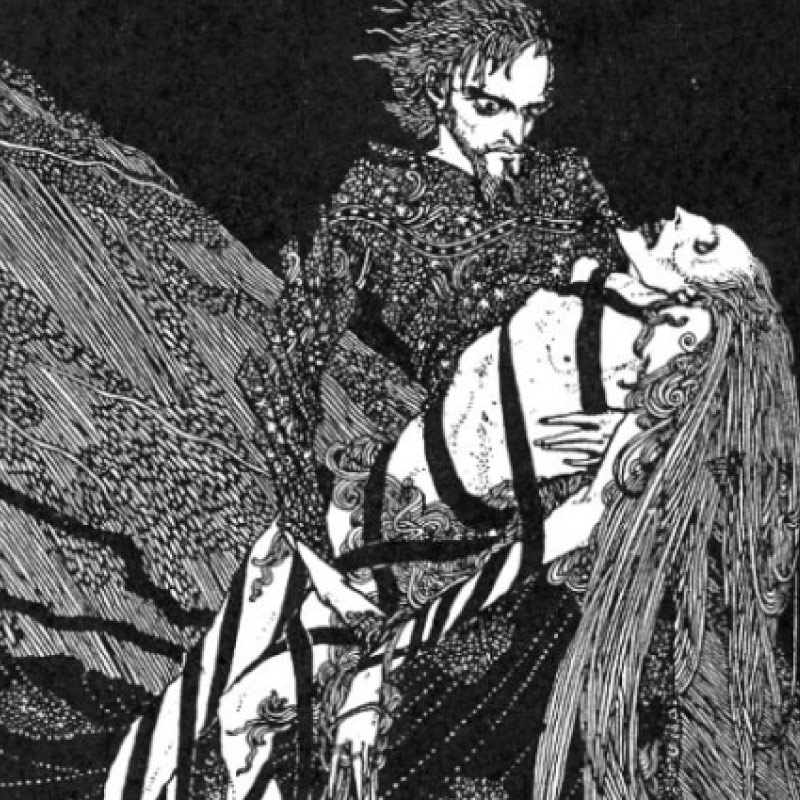
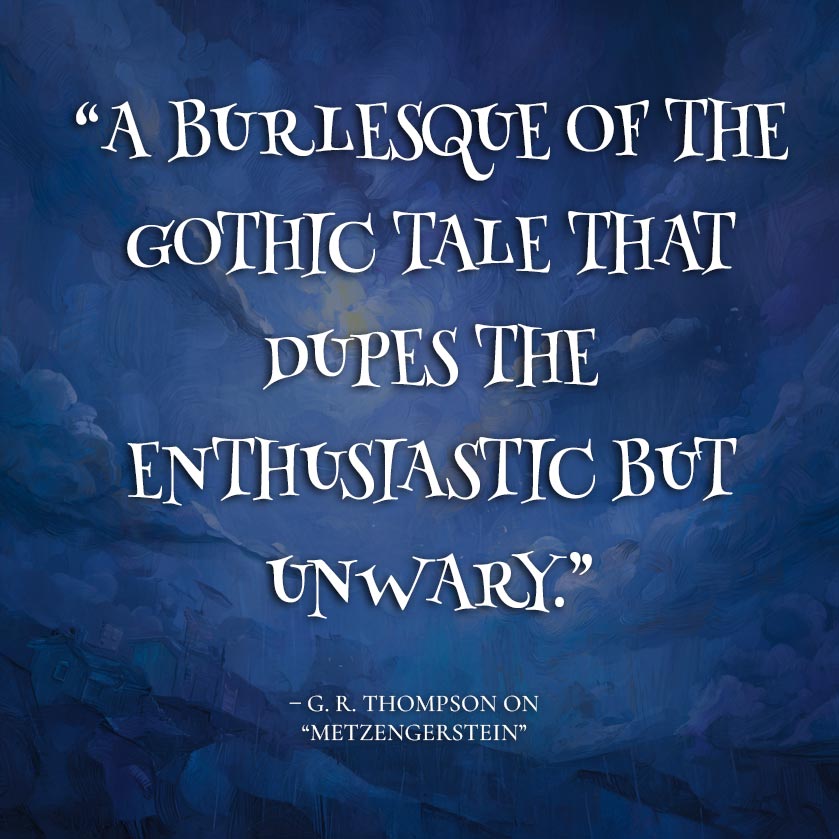
Metzengerstein. An ancient feud comes to a head when Count Berlifitzing is reincarnated as a horse.
Ms. Found in a Bottle. Terrors galore for a seafarer who gets catapulted onto the Flying Dutchman, which is pulled to the south pole and disappears into a giant whirlpool.
Silence—A Fable. A cryptic prose poem featuring lots of weather, shrieking water lilies, and a man sitting on a rock.
Von Kempelen and His Discovery. Ostensibly an article about the scientist who has just discovered how to turn lead into gold. Widely considered a hoax, but numerous features signal its parodic intent.
It is worth returning for a moment to the list of Poe’s best-known tales. On traditional readings, these stories are all taken as serious, which would make them outliers among the majority of Poe’s tales. This peculiar divide vanishes, however, once you realize that most (probably all) of these tales actually contain tricks.
Poe Unmasqued
Two books reveal his long-hidden secrets.